
McKinley County Criminal Docket Searches
The free starting point is New Mexico Case Lookup. It pulls public case information from District, Magistrate, Municipal, and appellate courts across the state. Even so, it works as a summary search and not a document library. Pick the criminal category for a McKinley County criminal docket search. Narrow by court type and location before trusting any name result. A full case number, when you have one, is the sharpest search key of all.
Use the summary to pin down the court and case status. Then call the clerk who keeps that court's file. Do that when you need an older record, a copy, or help with a setting. The McKinley County District Court clerk handles District Court files. Magistrate and Municipal files sit with their own clerks. Case Lookup does not promise that every docket entry or filing appears online.
- Open Case Lookup and select the criminal category, shown in official help as CR.
- Choose the court type and location filter that fits the known court, then enter a full case number or the public name-search fields.
- Open the matching summary and compare the court, category, status, filed date, and scheduled hearings.
- Use the responsible clerk for a court-file question, an older record, or a copy request, rather than relying on a search result alone.
Note: A name search can return more than one public case summary, so confirm the court and location fields before drawing any conclusion.
McKinley Criminal Lookup Filters
Official Case Lookup help covers name search and full case-number search. It also offers a DWI search link in the legacy interface. Criminal cases carry the CR code. The form can also limit results by court type, location, filing date, or hearing date. Spell names exactly; close is not close enough. A date filter helps when you know a narrow filing or hearing window. But it should never replace the court and category check.
The official legacy Case Lookup search reference lays out why those filters matter. The statewide system spans several court levels. So a broad name entry can blend records that never belonged to the same McKinley County criminal court docket.
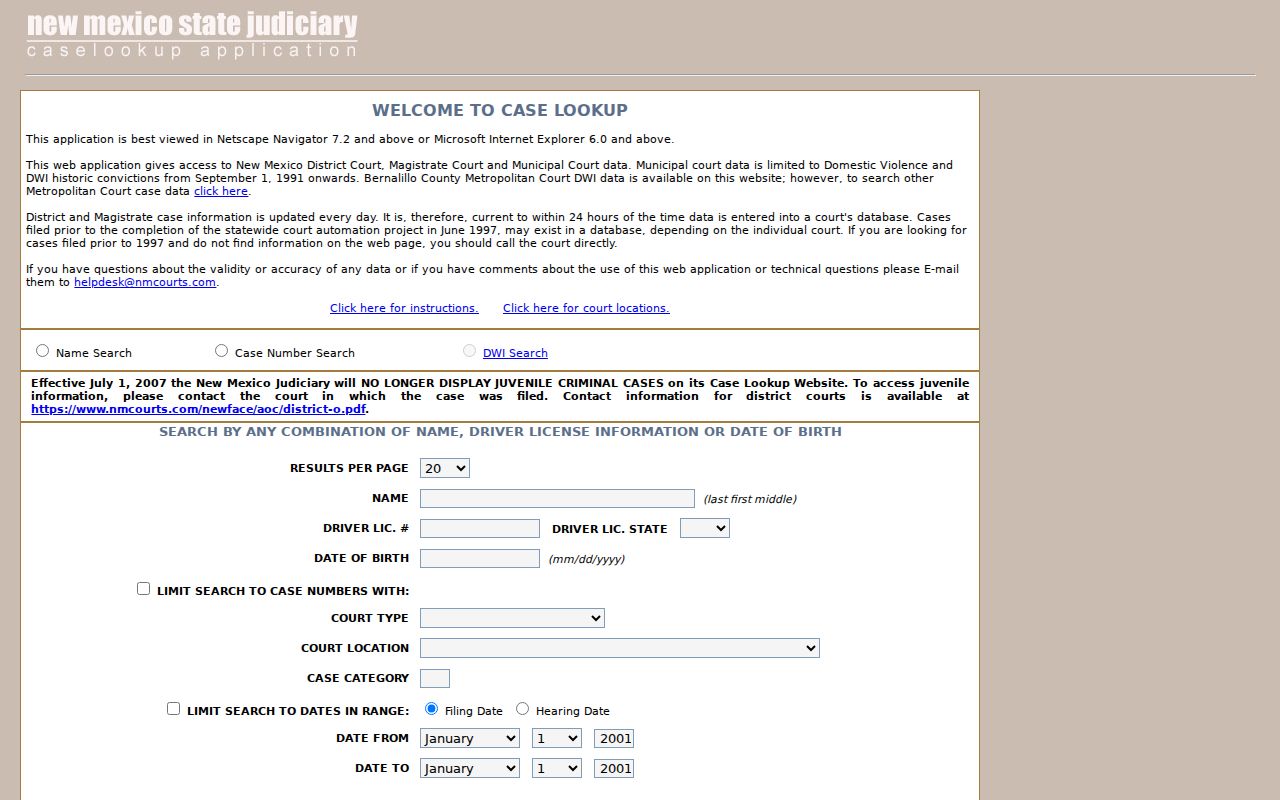
Treat the field layout as a reference only. The live portal may show JavaScript or CAPTCHA screens, and its visible options can shift over time. That does not change what the filters are for.
Criminal Dockets: What They Show
A McKinley County criminal register of actions places the case header beside its dated events. Case Lookup may show the case number, court location, category, status, parties where public, and scheduled hearings. Register for re:SearchNM and you may see more case-detail fields plus eligible filings. Access still depends on your role, the court, document security, redaction, digitization, and any sealing or confidentiality rule.
| Case number | Uses the court’s type, location, category, year, and sequence structure. Do not guess a McKinley location code. |
|---|---|
| Charge | May list the sequence, offense date, description, statute, degree, disposition, and most recent event for each charge. |
| Hearings | Can show date, time, type, judge, location, result, and a cancellation or reschedule reason when entered. |
| Plea and result | The register can show plea, disposition, and sentence events with dates and judicial fields where available. |
| Events and filings | re:SearchNM uses these interchangeable labels for dated activity and can display document security information. |
A charge-level disposition can differ from the overall case status. A label of open, closed, or unknown is no substitute for reading the event history and any accessible final order yourself.
McKinley Criminal Documents and Events
Case Lookup and re:SearchNM do different jobs. Case Lookup hands out public summaries and hearing dates but no document images. A registered user can search re:SearchNM by cases, hearings, filings, or text inside documents, then narrow by location, case category, case type, status, or filed-date range. The portal's print view calls the chronology a register of actions.
Each event or filing there can show a date, event type, filing summary, filer, comments, documents, page count, and security. Where permitted, documents can be selected for download. A visible case header never guarantees access to every attached filing, because the state's role-based access policy, redaction, and the case's security setting all stay in force.
A hearing calendar and a register of actions answer different questions. The calendar is a forward schedule; the register records case activity over time.
Criminal Case Stages on the Docket
Criminal entries usually run from a filed charge into early hearings. Later settings follow, and a result is recorded. The exact path depends on the court and the charge. A Magistrate preliminary hearing is a lower-court felony stage only. It is not the final felony trial or disposition that belongs in District Court. Read each setting from the event type and result shown for that case. Never rely on a short calendar label alone.
Docket flow: Charge Filed › Arraignment › Preliminary or Pretrial Setting › Plea or Trial › Disposition › Sentencing
A plea, a judgment, and a sentence can appear as separate dated events. The charge description, degree, disposition, and sentence fields separate what happened to one charge from the broader case status.
McKinley Criminal Court Routing
McKinley County has more than one criminal docket custodian. Which court holds the record turns on the offense level and where the matter began. That routing matters when a Case Lookup result names a court you did not expect, or when a requested record is not sitting in the District Court file.
| Court | Criminal docket scope | Local record route |
|---|---|---|
| McKinley District Court | Felony prosecutions and general-jurisdiction criminal matters. | McKinley County District Court Clerk in Gallup. |
| Gallup Magistrate Court | Misdemeanors, driving while intoxicated (DWI), traffic, and felony preliminary hearings. | Gallup Magistrate Court Clerk. |
| Gallup Municipal Court | City petty misdemeanors, traffic, code, animal-control, and city-jurisdiction DWI matters. | Gallup Municipal Court Clerk. |
Felony preliminary proceedings can start in Magistrate Court and then move into District Court prosecution. A Gallup Municipal case stays inside city jurisdiction, so it is not a countywide alternative for every criminal matter.
McKinley County Criminal Docket Courts
Four courts split the McKinley County criminal docket work. McKinley County District Court in Gallup carries the felonies as part of the Eleventh Judicial District. Its register of actions stands apart from lower court records. Gallup Magistrate Court takes misdemeanors, DWI, traffic, and felony preliminary dockets. City ordinance cases live with Gallup Municipal Court. Check the court name on any public result before calling. That name tells you which clerk holds the file.
When a record is missing online, or a request needs formal routing, the Court IPRA portal can carry a specific enough request to the right judicial district. Spell out the court and the category. Add the case number if you have it, a date range, and whether you want to inspect or copy. One caution: the Administrative Office of the Courts does not hold each local case file itself.
McKinley Criminal Docket Workload
The FY24 statistical addendum reports workload at the Gallup Magistrate Court level. It does not cover the whole county court system. That single court logged 6,251 incoming cases between July 1, 2023 and June 30, 2024. Criminal matters made up 6,003 of them. Treat these as court-management categories, not tallies of people or signs of outcomes. They show why the court and category filter matters. The filter is useful in any McKinley County criminal docket search.
Drill into the Gallup Magistrate numbers and you find 3,691 incoming criminal traffic matters listed under a separate FY24 classification. That McKinley County figure counts neither people nor results. It also says nothing about District Court felonies.
For annual reports and statistical addenda, the New Mexico Courts reports and policies page remains the official source that publishes them each year.
Every figure here belongs to the Gallup Magistrate reporting unit alone. Do not recast it as a District Court count, a countywide felony total, a conviction tally, or a count tied to any individual case.
Access Rules for Criminal Dockets
New Mexico presumes court records are open. Docket entries and registers of actions stay public unless a statute, rule, or court order protects them. Online access runs narrower than that principle, though. Case Lookup gives only a redacted summary layer, and re:SearchNM access changes with your role and the record's security level. Masked personal data is the norm. Sealed or confidential material can stay unavailable even when the public case header still shows.
Key Rules:
Rule 1-079 NMRA presumes court records open while protecting personal information and governing sealing.
Order 23-8500-007 sets redacted, role-based online access and excludes sealed or confidential material.
New Mexico IPRA guidance describes inspection access subject to statutory exceptions and court-record rules.
Case Lookup leaves out juvenile criminal information dated after July 1, 2007. Protection-order records after July 1, 2008 are excluded too. So a blank search result proves nothing. It cannot tell you whether a matter existed, how it was decided, or whether its record is reachable through another lawful channel.
McKinley Criminal Older Record Checks
Official public-access help flags a gap: online information before June 1997 can be incomplete. An older criminal case that fails to appear is a reason to call the clerk. Name the court and rough date range, and ask about archival copies. Never read a missing summary as proof the case never existed. The same care applies when a public portal lags a recent database update.
For process questions, the New Mexico Courts expungement information sets out the current official route. A name search that comes up empty establishes no expungement, acquittal, or other outcome. To verify anything, look to a final accessible disposition. A judgment or a clerk's own response can also settle it.
The state court's expungement resource sits separate from any name search. Pair it with the court's current instructions before acting.